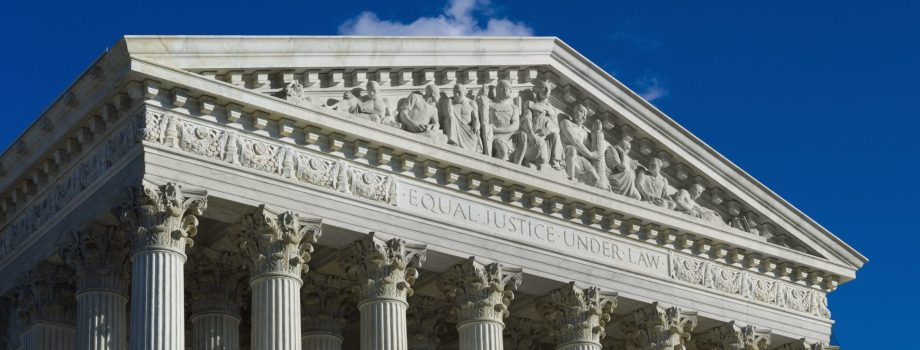
The U.S. Supreme Court heard oral arguments yesterday in Mahmoud v. Taylor, a case that seeks to dramatically expand the scope of the First Amendment’s Free Exercise Clause.
The case involves a challenge to a Maryland public school district’s decision to include books with LGBTQ+ characters in its language arts curriculum. The parent-plaintiffs demand the right to opt their children out of the curriculum, arguing that it burdens their religious freedom rights by exposing their children to ideas that they religiously disagree with.
Americans United filed a friend-of-the-court brief in support of the school district, arguing that the Free Exercise Clause does not give religious individuals a right to be shielded from ideas they oppose. The brief – joined by 11 religious and civil-rights organizations, representing a diverse array of faith perspectives – explains that expanding the Free Exercise Clause to require schools to allow religious parents to opt their children out of instruction they disagree with would harm religious freedom and stymie public schools’ ability to foster tolerance.
During oral argument, attorneys representing the parent-plaintiffs and the U.S. Solicitor General’s Office urged a major expansion of the Free Exercise Clause that would allow religious individuals to challenge any government action that they religiously disagree with. Several of the justices noted the potentially troubling results of such an expansion. Justice Sonia Sotomayor, for example, cited a real case where religious parents objected to the inclusion in a public school curriculum of books featuring women working outside the home, noting that under the parent-plaintiffs’ view, those parents would be equally entitled to opt their children out of those materials.
And the Free Exercise expansion advocated for by the plaintiff-parents wouldn’t stop at school curricula. Under the plaintiff-parents’ theory of religious freedom, Justice Ketanji Brown Jackson observed, religious parents could sue to block their child from being put in a classroom with a transgender classmate, or to prevent their gay teacher from displaying a wedding photo on her desk. The parent-plaintiffs’ view would also allow challenges outside the school context. As Sotomayor pointed out, if exposure to opposing views is enough to make out a Free Exercise Claim, a religious adherent could even challenge the inclusion of “women on this court in positions of work outside the home.”
As AU argued in its brief, religious freedom is harmed when students are opted out of instruction they disagree with. A core purpose of public schools is to prepare students for adult life in a pluralistic democracy. Part of that preparation necessarily entails learning to peacefully coexist with different views, even (and, perhaps, especially) with views we vehemently disagree with.
An opt-out system like that demanded by the plaintiff-parents in this case would severely undermine schools’ ability to prepare students for good citizenship in a religiously and philosophically diverse country. Students pulled out of any instruction they religiously disagree with would learn to have zero tolerance toward any ideas that do not align with their worldview. Religious minorities – a group whose views are most likely to be outside the mainstream, and for whom tolerance is most critical – would bear the brunt of the resulting rise of intolerance.
Moreover, in many cases, schools would not be able to administer an opt-out system at all. The school district in this case, for example, found that it would be “infeasible” to manage an opt-out system because teachers and other instructors would be expected to “track and accommodate” multiple, individual opt-out requests across different classrooms. Therefore, if the parents succeed, they will not just obtain an opt-out for their own children; they will most likely force the school district to remove the offending books from its curriculum altogether. Religious parents will thus be allowed to dictate the contents of the curriculum, for all children in the school system, in service of their own religious beliefs.
