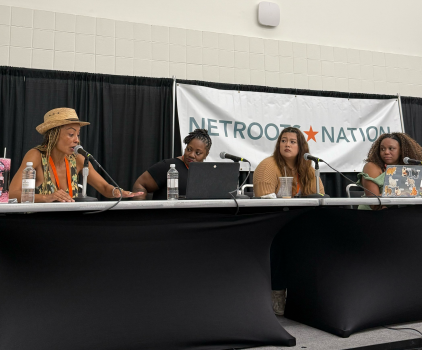
At Netroots Nation 2025, I had the honor of moderating AU’s panel, “Queer, Black and Brown: Resisting Christian Nationalism in Our Communities.” From the moment people began filling the room, it was clear there was an energy and curiosity about this topic. Across more than 400 sessions at Netroots, ours was one of the only conversations that put Christian Nationalism (CN) at the very center. We didn’t treat it as a passing reference or one issue among many. We named it for what it is: a political ideology designed to consolidate power and control, especially over communities already at the margins – queer people, people of color, women, trans and nonbinary people, people living in poverty and those outside dominant faith traditions.
Together with the Rev. Naomi Washington-Leapheart (Political Research Associates), Alanah Odoms (ACLU Louisiana), and AU Youth Fellow Chloe Serrano, we broke down how CN fuels attacks on LGBTQ+ rights, reproductive freedom, racial justice and public education and how those attacks are coordinated. We talked about why centering the voices of those most impacted is not optional but essential to resisting it. We gave people the language and tools to recognize how CN is already affecting their work, even if they hadn’t called it by name before. People stayed. They leaned in. The session ran 30 minutes over because no one was ready to leave.
Afterward, Camille Didelot, AU’s digital fundraising manager, heard from a woman at Catholics for Choice who said it was “easily the best panel in the entire conference.” Another attendee told me they appreciated how grounded the conversation felt, that it connected to the people in the room instead of floating above them. That feedback wasn’t just a nice pat on the back. It was a reminder of why these conversations are needed in spaces like Netroots. This convening brings together organizers and activists who are already doing critical work on the issues most impacted by CN. Still, many may not know the term or the scale of the coordinated efforts behind it. When someone working on climate justice, labor rights, reproductive freedom, or education policy walks out of our session, seeing how CN is a common thread in all those fights, that’s a win. It means we’re expanding the conversation, not just within AU’s orbit, but across movements.
That’s the work we’re committed to doing: creating and holding space for these conversations in the rooms where people are being most harmed, not only to share what we know, but to learn from others and build strategies together. We want to equip organizers, educators, faith leaders and advocates in every movement with the tools and resources to fight Christian Nationalism, and we also want to understand what’s working in their contexts. It’s a two-way street. Netroots gave us that chance.
In the exhibit hall, our booth became a hub for connection. We met public school educators worried about religion creeping into their classrooms, reproductive justice advocates navigating hostile legislatures, faith leaders reclaiming their traditions from extremists and grassroots organizers taking on book bans and anti-DEI laws. Over and over, we heard: “I didn’t know AU worked on this.” By the time those conversations wrapped, people understood that defending church–state separation is about so much more than keeping religion out of schools; it’s the foundation for reproductive freedom, LGBTQ+ equality, racial justice and democracy itself. These weren’t surface-level chats. People left with resources, language to name what they’d been experiencing, and a clearer vision of how AU could be a partner in their fight. In some cases, we started mapping out ways to stay connected through local organizing, chapter work or future collaborations.
What we accomplished at Netroots was a collective effort. While I was in the panel room, Camille was capturing photos, recording clips, and catching audience reactions. Noelle Ramsey, AU’s senior director of direct response marketing, stayed at the booth so our fellows could attend the session. And our fellows, when they weren’t in their own sessions, were the face of AU in the exhibit hall, helping people connect their work to ours and showing what it means to fight for freedom without favor and equality without exception.
Netroots reinforced what we already know: Christian Nationalism thrives when our movements are siloed. It relies on reproductive justice advocates, racial justice organizers, educators and LGBTQ+ activists to not recognize the interconnectedness of our struggles. But when we bring people together, give them a shared language, and name the root cause, we make it harder for CN to divide and conquer. That’s why AU is committed to showing up in spaces like Netroots and creating opportunities for this kind of cross-movement dialogue. And it’s why we’re carrying this energy into the Summit for Religious Freedom 2026 in the greater Washington, D.C., area, where these conversations will go even deeper and the connections will grow stronger.
If you were in that room, stopped by our booth or are just hearing about this now, we hope you’ll keep building with us.
Stay in the loop: Sign up for AU updates.
Be in the room: Join us at SRF 2026.
Keep connecting: Follow AU (Facebook, Instagram, Bluesky, YouTube and LinkedIn) and share how church-state separation connects to your own work. We’re not just talking about White Christian Nationalism. We’re organizing to dismantle it — together.
